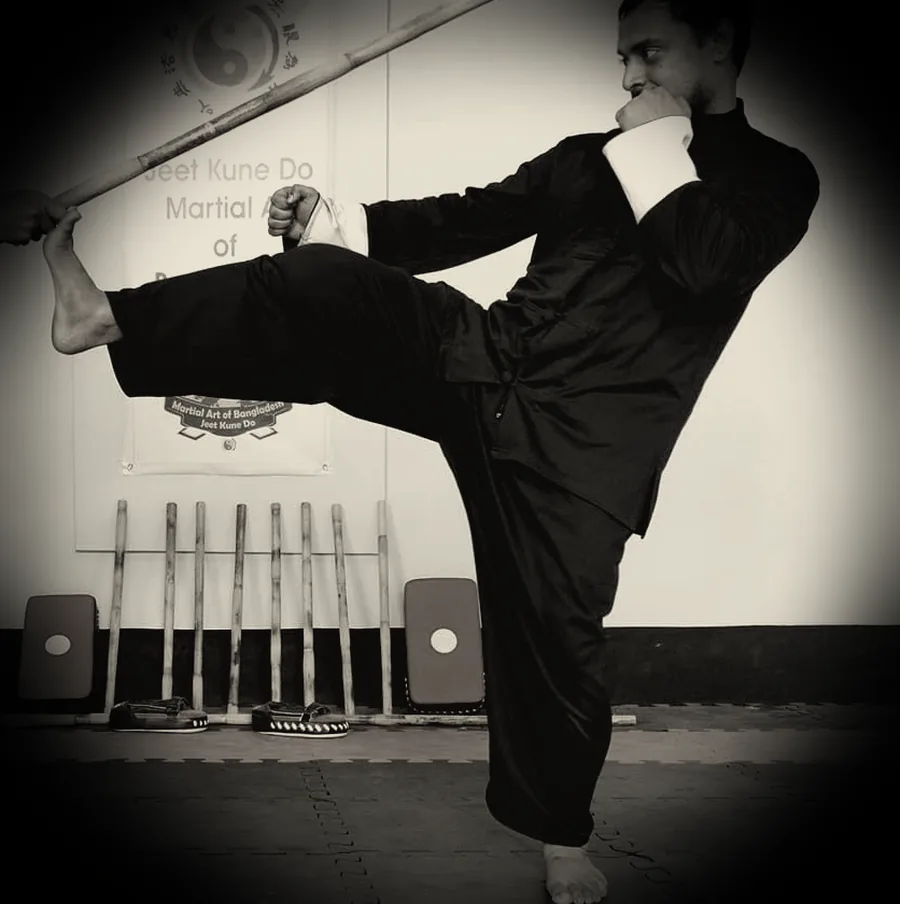
Beginners usually want to learn punches. The faster progress comes from learning where to put their feet. Footwork decides whether you are in range, out of range, balanced, or falling into someone else's attack.
This is not a complete footwork system. It is a practical starting point you can use before your first class in Dhaka.
Why feet come first
Your hands can only reach as far as your stance allows, and your balance depends on where your weight sits. If your feet are crossed, too narrow, or flat, every technique becomes harder. Good footwork lets you enter, exit, and change angle without losing structure.
Start with stance
A beginner stance should feel stable, not stiff. Feet roughly shoulder-width or slightly staggered, knees soft, weight centred, and the body able to move in any direction. Keep the guard up, but do not lock the shoulders.
Test it: can someone push your shoulder lightly without making you fall? Can you step forward and back without crossing your feet? If not, the stance needs work.
Step and pivot
- Lead step: move the front foot first, then bring the back foot with it. Keep the same distance between your feet.
- Rear step: move the back foot first when retreating. Do not lean backwards before the feet move.
- Pivot: turn on the ball of the foot to change angle while keeping your guard and balance.
- Distance: practise entering and leaving range without reaching with your upper body.
Simple drills
Use a line on the floor. Step forward and back for one minute, keeping your head at the same height. Then add a pivot at each end. Next, have a partner move slowly and mirror their distance without touching them.
Keep the drills short and honest. Speed comes later. If you cannot stay balanced at a slow pace, going faster will only hide the problem.
Common mistakes
- Crossing the feet and losing base.
- Leaning forward before stepping.
- Standing tall and locking the knees.
- Watching the feet instead of the partner.
- Chasing speed before balance.
At JKDBD, footwork is part of the JKD fundamentals and every beginner session. If you want to see how it fits into training, check the schedule or send a message.
Quick questions
How long does it take to learn footwork?
You can learn the basic shapes quickly. Using them under pressure takes longer. Expect repeated practice, not a one-day fix.
Do I need special shoes?
Ask the school. Many train barefoot or in flat training shoes. Avoid thick running shoes that make balance harder.
Discussion
Comments (0)
Comments are public. Please keep personal information out of the thread.
Loading comments…