01
Simplicity
Remove what is unnecessary.
Keep only what works. Remove wasted motion, hesitation, and decoration.
What is Jeet Kune Do?
Bruce Lee’s Jeet Kune Do is not a fixed style. It is a way of training the body and mind to intercept, adapt, and express what is honest.
The idea
Bruce Lee developed Jeet Kune Do in the late 1960s as a departure from rigid styles. He was interested in what worked — not what looked traditional. JKD became a process of stripping away the unnecessary, intercepting the attack, and responding with economy and intent.
The name points toward interception: jeet means to intercept, kune do the way of the fist. But the deeper practice is adaptability. The art changes as the situation changes, and as the practitioner learns what is true for them.
At JKDBD, that means no empty choreography. We study structure, distance, timing, and partner application — then we test what we have learned. Philosophy is welcome here, but it has to move.
“Absorb what is useful, discard what is not, add what is uniquely your own.”
Bruce Lee
The principles
These are not decorative slogans. They are the filters we use when deciding how to train, what to keep, and what to discard.
01
Remove what is unnecessary.
Keep only what works. Remove wasted motion, hesitation, and decoration.
02
Take the shortest path.
Intercept before the attack develops. The straight line is often enough.
03
Your game, not a copy.
No fixed imitation. Train until the response becomes honestly yours.
The four ranges
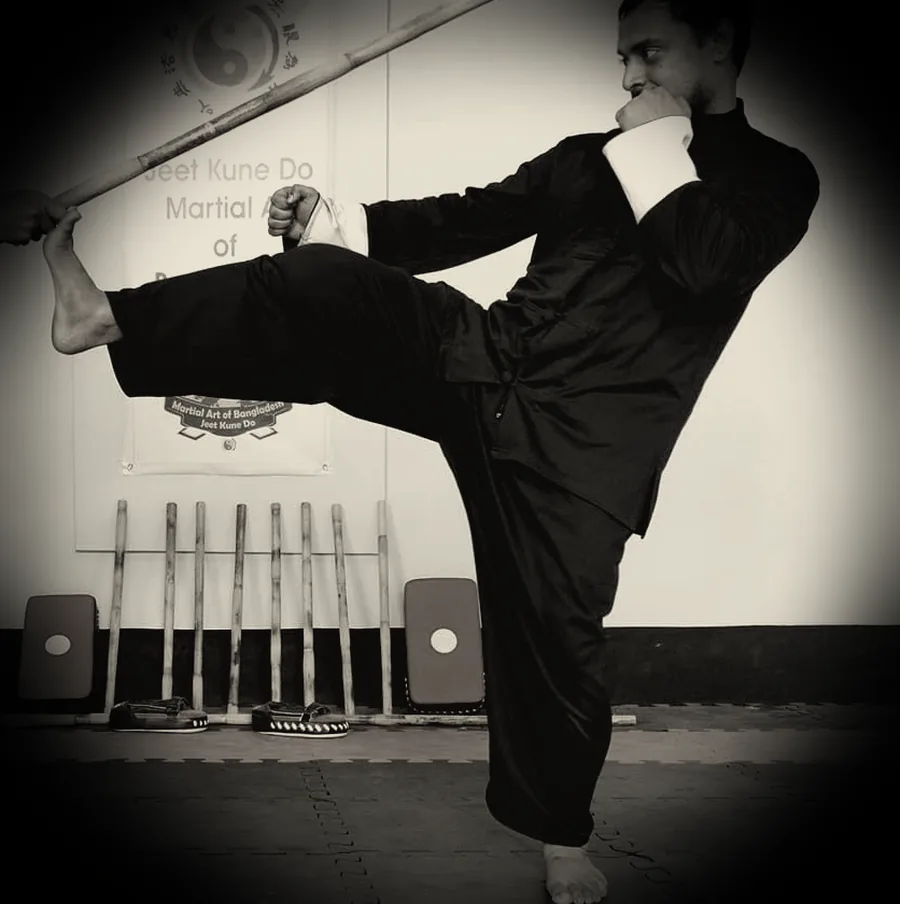
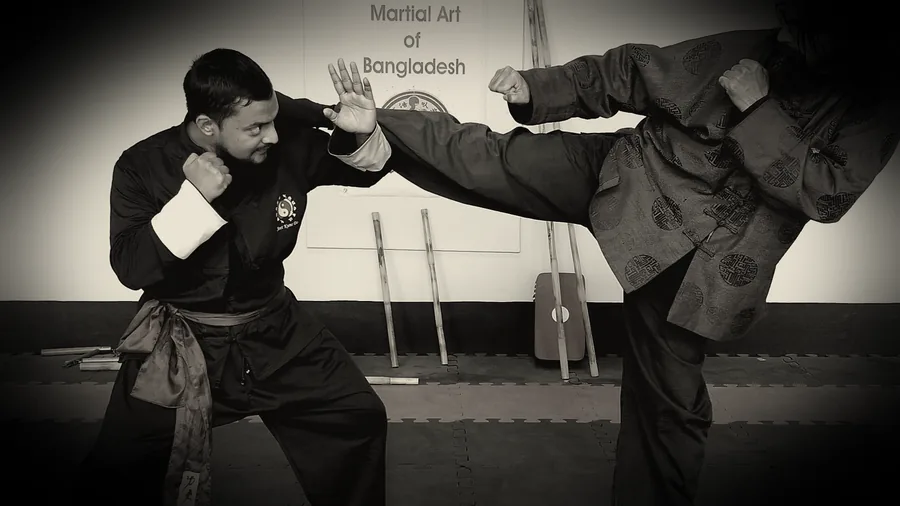
JKD does not live in one distance. JKDBD uses four training ranges — kicking, punching, trapping, and grappling — to organise that work. This is our training framework, not a claim that JKD was historically codified into four fixed ranges.
01
Long-range tools, balance, and the ability to enter or exit without losing structure.
02
The straight lead, economy of motion, and hand speed that arrives without warning.
03
Close-range control, parries, and the interception of an opponent’s structure.
04
Clinching, takedowns, and ground awareness — because a fight has more than one range.
The thread through all four
Interception. Economy. Awareness. The ability to enter, control, and leave without wasting motion.
Bruce Lee’s philosophy
Be water,
my friend.
Water takes the shape of its container. It does not argue with the ground; it finds a way around it. In training, that means being present enough to adapt — not clinging to a favourite technique or a fixed idea of how a confrontation should look.
In practice
Footwork, broken rhythm, and live partner feedback.
In life
Less rigidity. More attention. A calmer response under pressure.
Honest training begins by clearing away the myths around the art — and around Bruce Lee himself.
It is not a collection of secret moves. It is a process of training useful responses.
It is not a style you copy. It is an approach you make honest for your own body.
It is not about violence. It is about capability, awareness, and the confidence to avoid what can be avoided.
It is not officially connected to the Bruce Lee Estate. JKDBD is an independent training organisation.
Explore our training tracks or speak with JKDBD directly. Beginner entry is welcome, and the first step is simple.