Bruce Lee’s philosophy is often reduced to a few quotations and a film image. The useful part is harder: it asks you to test what you do, keep what works, and stay flexible when the situation changes.
This is an introduction for beginners, not a substitute for training or a complete history of Jeet Kune Do.
Who Bruce Lee was
Bruce Lee was a martial artist, teacher, and actor whose work brought attention to Chinese martial arts and to the idea of cross-training. He developed Jeet Kune Do in the late 1960s as a departure from rigid styles. He was interested in what worked, not what looked traditional.
He was also a human being, not a myth. A useful philosophy should survive contact with ordinary training, including bad days, injuries, and the limits of your own body.
The core ideas
- Simplicity: remove what is unnecessary before adding more.
- Directness: take the shortest useful path rather than the most decorative one.
- Interception: deal with the attack as it forms, not after it has landed.
- Adaptability: do not confuse a plan with reality.
- Honest self-expression: stop imitating someone else’s body and temperament.
The quotations
“Absorb what is useful, discard what is not, add what is uniquely your own.” This is a test, not a licence to collect techniques randomly. You still need a base, repetition, and feedback.
“Be water, my friend.” Water takes the shape of its container. In training, that means being present enough to adapt rather than forcing a favourite technique onto every situation.
“Using no way as way, having no limitation as limitation.” This is often repeated in JKD circles. It does not mean having no method. It means not becoming trapped by one.
Note: these quotations are widely attributed to Bruce Lee, but exact wording and sources can vary between editions and interviews. Verify any quotation before publishing it as an exact historical citation.
What JKD is not
JKD is not a secret collection of deadly moves. It is not a guarantee of winning fights. It is not a reason to abandon fundamentals or to imitate Bruce Lee’s mannerisms. A good class should be able to explain what it teaches and how it tests it.
Philosophy in practice
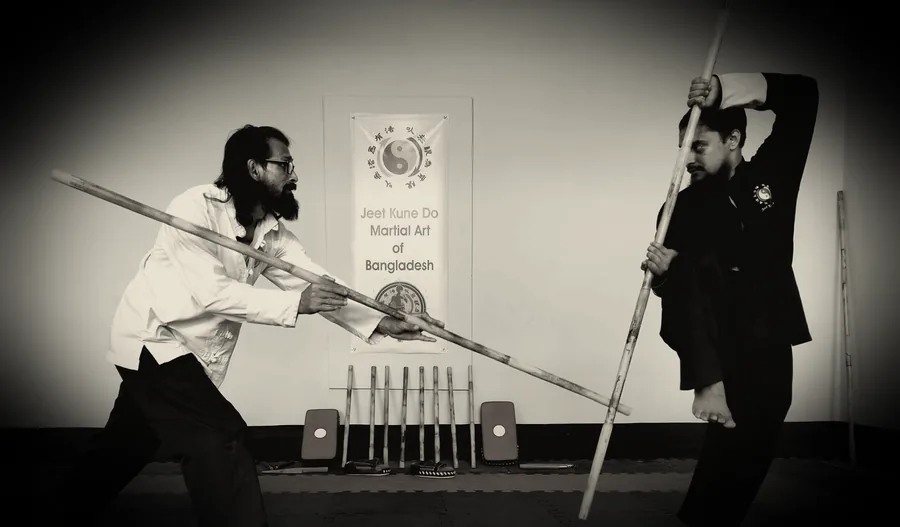
At JKDBD, the philosophy lives in small decisions: simplifying a technique, changing distance, asking why a drill exists, and accepting correction. It should show up in the way a class is taught, not only in a quotation on a wall.
If you want to see how this works in training, read what Jeet Kune Do is, see the training tracks, or start a conversation.
Quick questions
Do I need to agree with Bruce Lee’s philosophy to train JKD?
You need to be willing to test ideas and accept correction. Philosophy is not a loyalty test; it is a practical filter.
Was Jeet Kune Do invented by Bruce Lee?
Bruce Lee is credited with developing JKD in the late 1960s. Historical details and lineages are debated, so treat simple origin stories with care.
Discussion
Comments (0)
Comments are public. Please keep personal information out of the thread.
Loading comments…